A working method for building real software when you came up as an operator, not an engineer.
The first question people ask when they see the work is some version of the same thing: you built all of that — alone? The second, once they’ve accepted the first answer is yes, is more pointed: isn’t that just vibecoding?
It’s a fair question, and the honest answer is no — but the reason is more interesting than a defensive denial. The difference between vibecoding and shipping production software with AI isn’t the tools. It’s everything that happens around the tools.
Let me back up.
I didn’t come up as an engineer. I came up as an operator. I ran my own digital agency in the early commercial-web era — SEO, SEM, web development, carrying a P&L through the dot-com cycle before any of it was a tidy category. Then fifteen years inside Fortune 500 rooms, implementing, integrating, and selling enterprise software at a scale where “it mostly works” is not a sentence anyone is permitted to say. No computer-science degree. For most of my career, “I could just build that myself” was not a claim I could honestly make.
That changed — not because I learned to type code faster, but because the nature of the work changed.
Here is the method, stated plainly: I treat the AI as a junior engineer, and I am the senior engineer accountable for everything it produces.
That sentence carries the whole distinction, so let me unpack it.
Vibecoding is prompting a model until something kind of works, then shipping it. No architecture, no review, no working definition of “correct” beyond “it ran.” That’s fine for a weekend toy. It falls apart the instant real data, real users, or real money arrive.
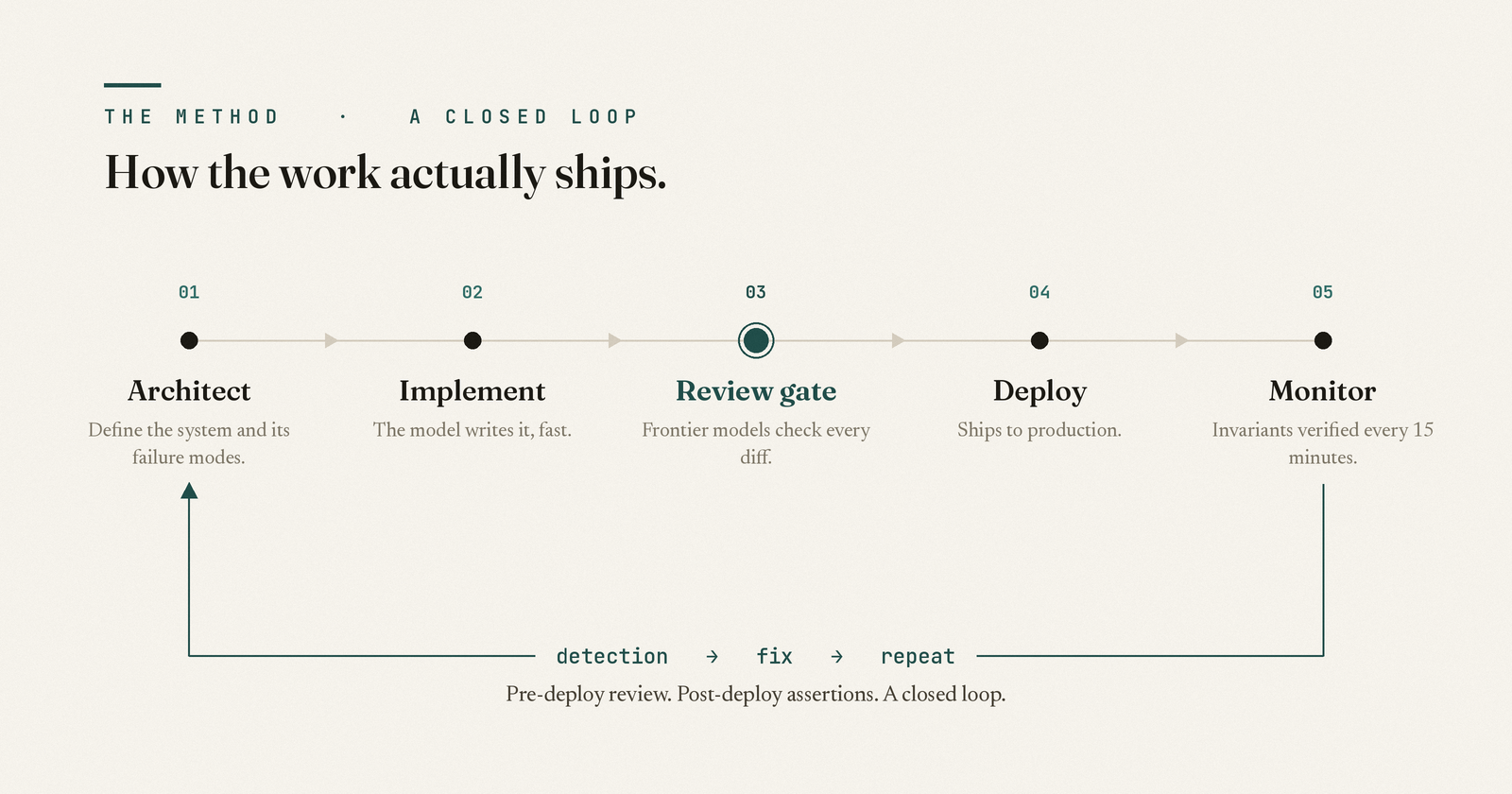
What I do starts from the other end. I architect the system first — the data model, the failure modes, the boundaries — the same way I’d brief a capable junior on a real project. Then the AI writes the implementation, fast. And then I review every meaningful piece of it the way a senior reviews a pull request: not does it run, but is this right, is it safe, what happens when the input is malformed, what breaks under load. The AI is astonishingly productive and genuinely fallible. Both are true at once, and the discipline lives in holding both at the same time.
The part nobody sees — the part that actually separates a demo from a system someone pays for — is what happens between “it works on my machine” and “it’s running in front of customers.”
Every change runs through a multi-model review gate before it deploys. Several frontier models review each diff; different models have different blind spots, and stacking them catches what any one of them misses, including me. Nothing ships on a single reviewer’s say-so. After deploy, an agent checks every fifteen minutes that the system is still doing what it’s supposed to — not “is the server up,” but “did the pipeline actually process what it should have, did an invariant quietly drift after a migration.” When something’s off, it routes to a person who fixes it, usually before the client notices. Pre-deploy review, post-deploy assertions, a closed loop. That’s not vibecoding. That’s the unglamorous machinery of production, and it’s the entire game.
What that method has produced, working solo: a platform that measures how a brand appears across the major AI assistants and turns it into a concrete fix list. A real-time voice receptionist that answers, qualifies, and books appointments in under half a second of latency, end to end. A customer-data platform that unifies phone calls and web forms across hundreds of law firms into one clean identity per firm, with AI triaging every record as it arrives. Voice, SaaS, data infrastructure, iOS — different stacks, different verticals, all in production. No team. No project manager translating between people who each see one slice of the problem.
Here’s what I think operators and executives should take from this, beyond the novelty of one person doing it.
The binding constraint on building software used to be the ability to write it. That constraint is dissolving. What it leaves behind is everything that was always the hard part and is now the only part: knowing what to build, architecting it so it doesn’t collapse, recognizing when an answer is wrong, and owning the outcome when it ships. Judgment. Accountability.
AI doesn’t remove the need for those. It removes the excuse not to have them. The people who’ll get the most out of this moment aren’t the best prompters — they’re the ones who already know what done, correct, and safe mean, and now have a tireless junior who can implement at the speed of their thinking.
AI doesn’t remove the need for judgment. It removes the excuse not to have it.
That’s the real shift. It isn’t that anyone can suddenly build anything. It’s that the distance between an operator who understands a problem deeply and the working software that solves it just got very, very short.
I find that more exciting than any single thing I’ve shipped.
— Adam C. Higdon